

Debt Consolidation Rises to 39% of Home Equity Borrowing as Renovation's Share Declines, MBA Data Shows
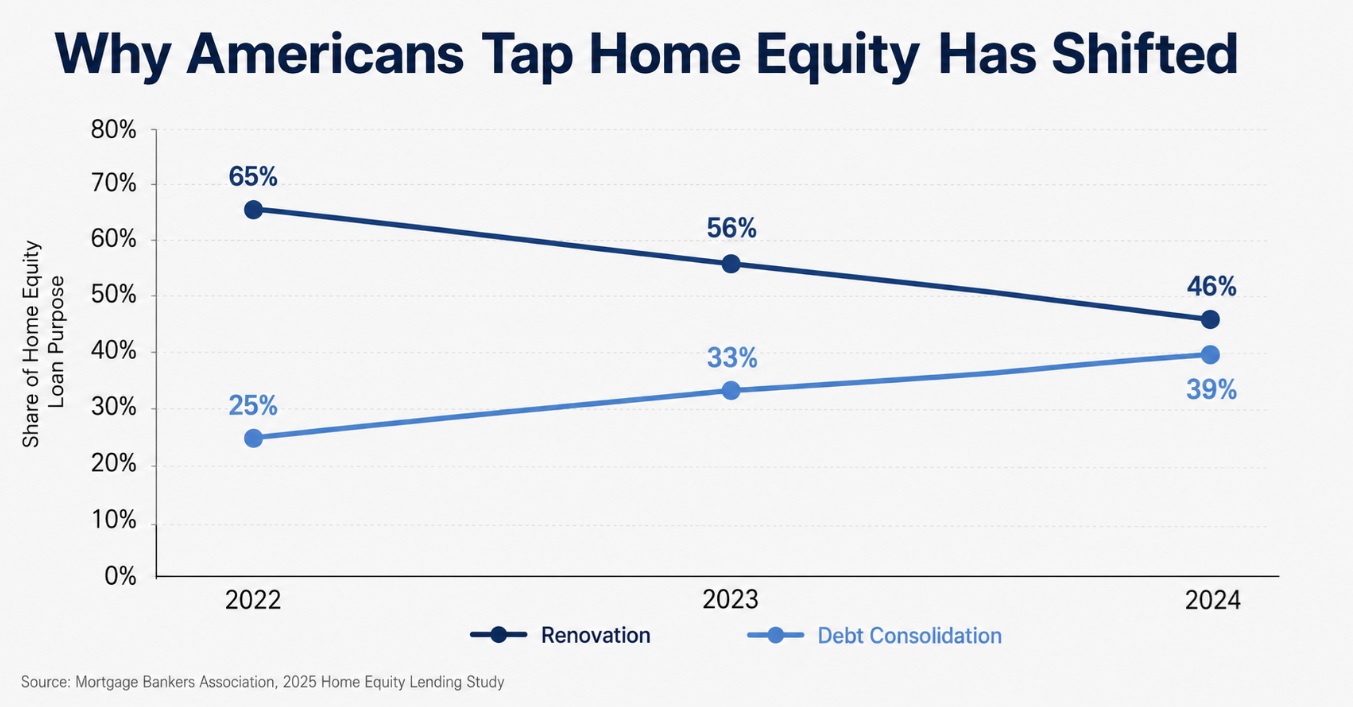
Debt consolidation's share of home equity borrowing rose from 25% to 39% between 2022 and 2024 while renovation's share fell from 65% to 46%, according to the Mortgage Bankers Association.
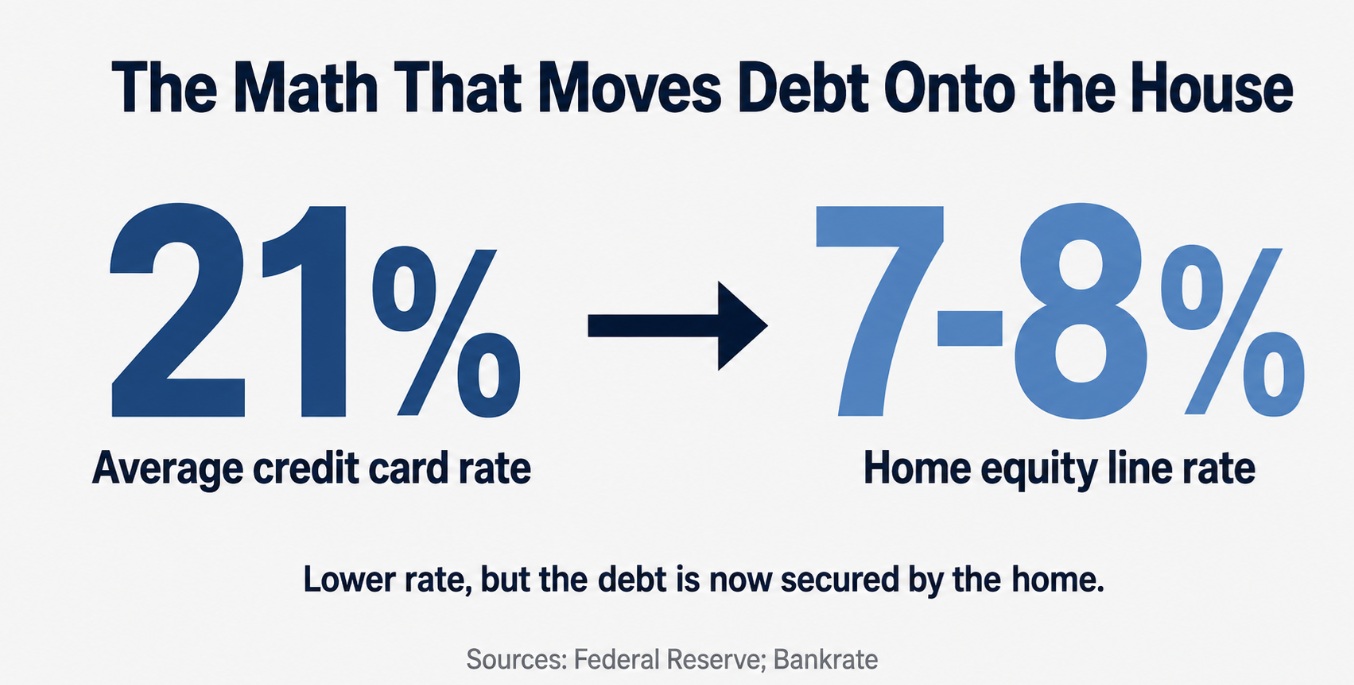
The average credit card rate near 21% versus a home equity line in the 7% to 8% range is the gap pulling borrowers to move unsecured debt onto their homes, per Federal Reserve and Bankrate data.
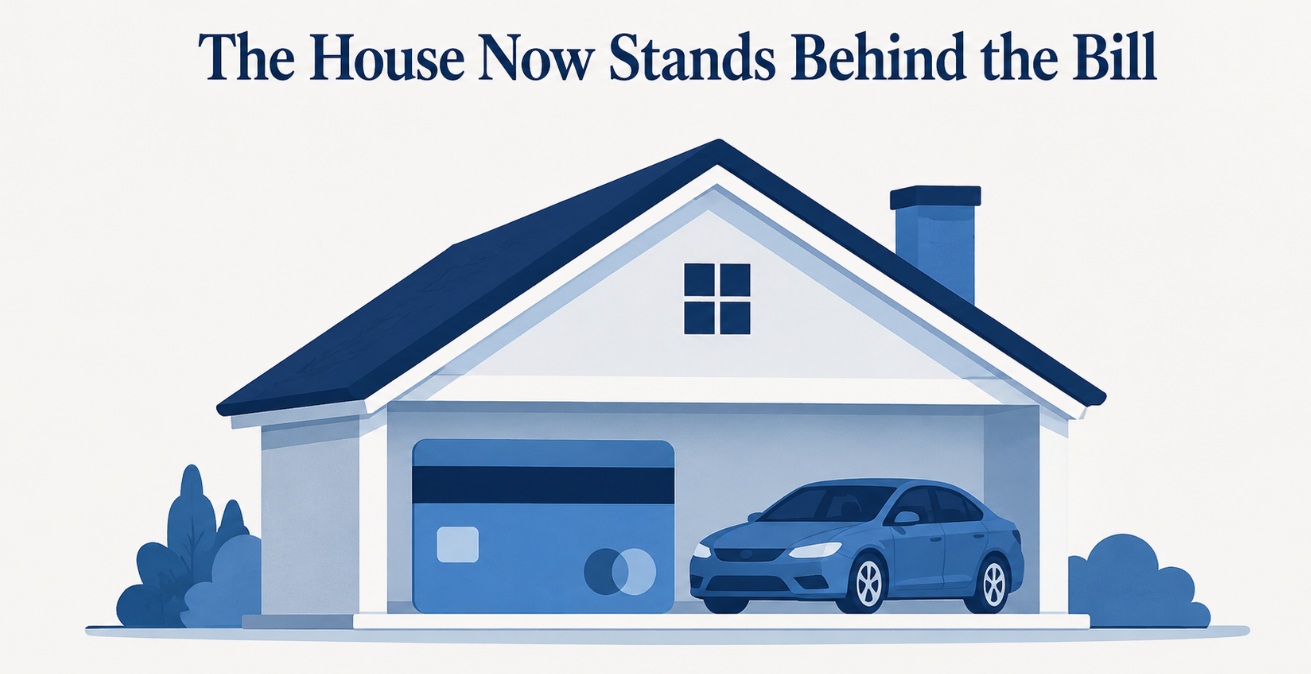
As more homeowners consolidate credit card and auto debt into home equity products, balances once unsecured become debt secured by the house itself.
Borrowers are increasingly moving credit card and auto debt onto their homes, converting unsecured balances into debt secured by the property.
The Reasons Homeowners Borrow Are Changing
The Mortgage Bankers Association tracks why borrowers open home equity lines of credit and home equity loans. Its 2025 study, covering full-year 2024 data, found renovation still leads but is shrinking fast, while debt consolidation is closing the gap. Renovation fell from 65% of volume in 2022 to 56% in 2023 to 46% in 2024. Debt consolidation rose from 25% to 33% to 39% across the same years. The crossover is not complete, but the direction is clear. Homeowners are increasingly using the value in their walls to pay down balances they ran up somewhere else. The changing mix suggests more borrowers are using home equity to manage existing obligations instead of financing property improvements.
Why the Math Pulls Borrowers Toward the House
The pull is simple arithmetic. The average credit card carried an interest rate of 21% in early 2026, according to the Federal Reserve. A home equity line costs far less, often in the 7% to 8% range, according to Bankrate's national lender survey. For example, a homeowner moving 30,000 dollars of card balances onto a home equity product can cut the interest cost substantially. The tradeoff is that unsecured debt becomes debt secured by the home. When that balance is refinanced onto the house, the property backs it. The interest rate drops, but the consequence of falling behind rises from a damaged credit report to the possible loss of the house.
For a disciplined borrower, replacing 21% card debt with a lower-rate home equity loan as part of a real repayment plan can be a sound financial move. The risk runs the other way when the original credit cards get charged back up. A borrower who consolidates and then rebuilds the balances ends up carrying both, with the house now backing one of them. The same tool that can reduce interest costs can also deepen total debt when the underlying spending does not change.
Borrowing Is Climbing Into 2026
This is not a story stuck in 2024. Homeowners pulled an estimated 47 billion dollars from their properties in the first quarter of 2026, the highest first-quarter figure since 2021, according to Intercontinental Exchange. Outstanding home equity line balances reached 446 billion dollars by early 2026, a sixteenth consecutive quarterly increase, according to the Federal Reserve Bank of New York. The same data shows the pressure behind the trend. Total household debt reached 18.8 trillion dollars, with credit card balances at 1.25 trillion dollars in the first quarter of 2026, up 63% from 770 billion dollars in early 2021. Non-housing debt, which includes credit cards, auto loans, and student loans, grew 56% over the past decade.
The Equity Is There to Tap
What makes the shift possible is the cushion built during the housing boom. The average mortgaged homeowner held roughly 295,000 dollars in equity at the end of 2025, with about 200,000 dollars of that tappable while keeping a 20% stake in the home, according to Cotality. That wealth is spread unevenly. Annual equity gains were strongest in the Northeast, with New Jersey homeowners adding about 26,100 dollars over the year, Wyoming about 23,100 dollars, and Connecticut about 20,300 dollars. Equity-rich conditions remain historically high across most of the country, even as price growth has cooled, which is exactly why how that equity gets used now matters more than how much of it exists.
A Tale of Two Borrowers
The same product now serves two very different households. One borrows against a low-rate first mortgage to add a bedroom, potentially recovering part of the investment through increased home value. The other moves a year of credit card and auto balances onto the house to escape a 21% interest rate, converting unsecured debt into secured debt without changing the spending that created it. One use is aimed at improving the property. The other is aimed at restructuring existing debt. The balance between them has tilted toward the second in just two years. Some industry analysts view the growing share of debt-consolidation borrowing as a sign that household financial pressures are increasing.
What It Means for Homeowners
The equity cushion is a genuine financial advantage, and using it is not inherently a mistake. The distinction is purpose. Borrowing that improves the home or replaces costlier debt as part of a real repayment plan can strengthen a household balance sheet. Borrowing that simply re-secures a spending problem against the property raises the stakes without solving it. For owners weighing the move, the questions are whether the spending behind the debt has changed and whether the home can safely carry the new lien. Companies that work with homeowners, including Buys Houses, increasingly encounter owners using home equity for very different purposes, from renovation to debt management. Home equity is increasingly doing the work that credit cards used to, and the house is now standing behind the bill.
About Buys Houses
Buys Houses is a Pittsburgh-based company that purchases homes for cash, including inherited, distressed, and as-is properties. The company is part of the we buy houses category of cash home buyers, working with owners who need to sell quickly or who face circumstances that make a traditional listing difficult. Buys Houses serves owners across Western Pennsylvania navigating financial strain, life transitions, or properties that need significant work, providing a direct cash option for those situations.
Carlo Finotti
Buys Houses
+1 412-561-9833
media@BuysHouses.co
Visit us on social media:
LinkedIn
Instagram
Facebook
Other
Legal Disclaimer:
EIN Presswire provides this news content "as is" without warranty of any kind. We do not accept any responsibility or liability for the accuracy, content, images, videos, licenses, completeness, legality, or reliability of the information contained in this article. If you have any complaints or copyright issues related to this article, kindly contact the author above.
